 There is a majesty to Italy, which is hard to describe to someone who has never been. Not only are you surrounded by centuries of history and incredible architecture. But you will also witness stunning landscapes, beautifully tied together by an alluring Italian culture.
Our three-week trip to Italy in May 2025, began as an opportunity to visit Milan due to crazy cheap flights. Somehow this trip kept expanding, as we added more cities in northern Italy. One of these cities was Verona, mainly because it was a stop between Lake Garda and Venice, but also, we’d heard incredible things about it. As with many locations in Italy, Verona is beloved because of its history, but we also felt that it was the ideal place to simply wander. Having spent over a week at that point, dashing from one location to the next. Verona gave us an opportunity to take a breath, relax and enjoy a stroll through its winding streets.
That doesn’t mean there isn’t plenty to see and do there. This guide will make your life easier by providing all the information you need, as you plan your perfect trip to this romantic location.
Verona’s old-world charm makes it the perfect mini break, especially if you’re visiting other cities in the area. Of all the places we visited, Verona was one of our favourites and somewhere we would visit again.
Ad Disclaimer!
This website uses paid adverts and affiliate links, these come at no additional cost to you and help us to fund the operation of the website, meaning we can continue to provide you with valuable content.
The money received from these links and adverts do not influence any recommondations made within our content.
Where is Verona and Why Visit?
The impressive Verona is the second largest city in the Veneto region, which can be found in Northern Italy. It’s roughly between Milan and Venice, which makes it a perfect place to tie in both locations. But it’s also ideal for those of you who are visiting Lake Garda, because there’s easy access via public transport or a short drive.
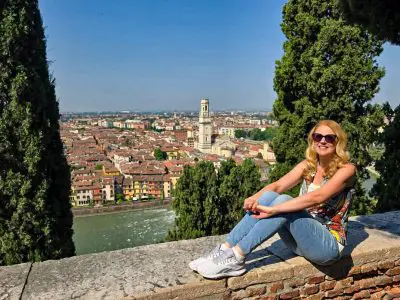
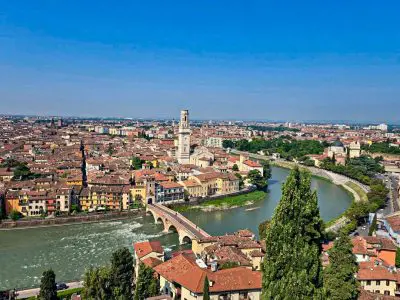
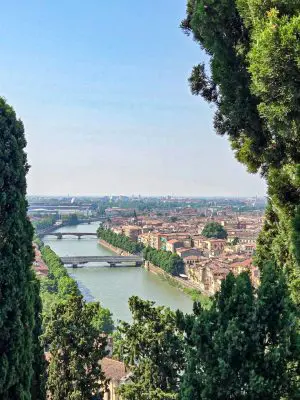
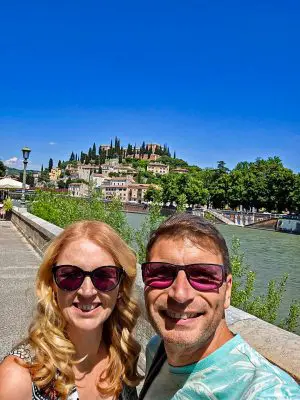
Verona sits along the Adige River which winds through the city, almost as if it was intentionally placed there. It creates the most beautiful views from places such as the Piazzale Castel San Pietro. These spectacular panoramas display Verona’s rich history and stunning architecture, with charming red rooftops which seemingly go on for miles.
During our time in Verona and by extension Lake Garda and even Milan, we heard a lot about the della Scala family who ruled the city between the 13th and 14th centuries. Yes, you may have connected the name to the famous opera house in Milan, Teatro alla Scala. In fact, the family impacted many parts of the region especially in architecture, due to the wealth and prosperity experienced during that time. We mention this because there are numerous monuments connected to the della Scala family, which you will visit during your time in Verona.
Known as the city of love, Verona is a top tourist destination for a number of reasons. Two more notable ones are its connection to William Shakespear’s tragic love story Romeo and Juliet, and its opera season in the arena. In November 2000 the city’s historic centre became a UNESCO World Heritage Site, which is understandable when you witness the incredible architecture with your own eyes. Historic Roman monuments such as the magnificent Arena have been preserved, as well as many early medieval artifacts.
But what we loved is that unlike many of the other Italian cities we visited, such as Rome or Florence, Verona felt more relaxed. This makes it an ideal place for those of you looking for a much slower place, whilst taking in the atmosphere.
So, why would you visit? There’s a long list of reasons, whether its to take in the culture, deep dive into the history, taste incredible delicacies or simply stroll with a gelato.
How Long Do I Need in Verona?
It can be difficult to know how many days you will need when you’re booking a trip to a city or tourist destination. You want to ensure that you have enough time to do everything, whilst balancing the cost of accommodation. Most of the time if we are planning a city break, we will opt for three or four full days. It means we can do all the attractions and activities, plus have some time to relax and take it all in.
Verona is a little different because although there is a decent number of things to do and see, most of it is a quick look and move on. So, you only really need a day or two, which is why we would recommend Verona as part of a bigger trip. You could add in beautiful Lake Garda or even take the train over to Venice. But if you want to spend some time relaxing then add a bit longer, because Verona is the ideal trip to enjoy Italian culture. It felt more authentically Italian than many of the bigger cities we have been to such as Rome and Milan.
How long you book will depend on the cost of flights and accommodation, with Verona being the more expensive of the cities we visited during our trip. Another point to consider is that we visited Verona in May, which would be considered a quieter part of the year. But it was extremely busy with tourists and school trips, which made it a little difficult to get into the popular attractions and walk through the central area. Of course, if you are heading there in the Summer, then it will be even busier.
Where to Stay in Verona?
Choosing where to stay can be a minefield when you don’t know the area. We struggled to find somewhere during our trip but managed to get a small apartment in the Cittadella area, which was only about 10 minutes’ walk to Verona Arena. You will find differing types of accommodation within the city, including hotels, bnb’s, hostels and apartments such as Airbnb’s. We quite like having access to a kitchen wherever we stay, so an apartment is our preferred option.
Where you stay will depend upon a number of factors such as your budget and mobility. But if you’re not restricted by those, then we would always encourage you to look at staying in Verona’s Historic Centre. It means that you’re in the action and can use those precious steps to get around the attractions in the city, rather than walking back and too the accommodation.
Aswell as the Historic Centre and Cittadella, the other areas which are close to the main attractions are Borgo Trento, Veronetta, Valdonega and San Zeno. They tend to circle the historic area, so will be less expensive and provide more parking space (if like us you have a hire car). Thankfully they are all still within walking distance to the historic centre and as such are viable options.
Another factor to consider is that accommodation may be noisier within the centre, whereas the outer suburbs should be quieter in the evening. But if you prefer to enjoy the nightlife and noise isn’t a problem, then again maybe centre yourself within the historic area.
Just so that you have a full breakdown, here are the best neighbourhoods for those of you wanting to explore Verona.
- Historic Centre – The Historic Centre can be found within a bend of the Adige River which winds through the city in a distinctive ‘S’ shape. Known as the Città Vecchia or Ancient City, the Historic Centre is enclosed by the Adige, Piazza Brà and Roman Walls. Being in the centre means you’re in the heart of the action. You’ll find incredible shops and restaurants pretty much everywhere, and the majority of attractions such as the Arena, Piazza Bra and Juliet’s House. There is plenty of accommodation options, whether you want a hotel or apartment such as an Airbnb. Of course this is the most expensive section in the area, because convenience always means higher cost. But depending on the type of accommodation, you may find the difference isn’t a huge amount, especially when compared to the extra steps you will be doing each day. As we mentioned above, parking is an issue the further you head into Verona’s Historic Centre, so if you have a hire car then it may be wiser to choose another suburb. The train station is around a 25-to-30-minute walk into the centre, but it may be a preferrable option if you want to stay close to the action.
- Cittadella – A district right next to the Historic Centre and the place where we stayed during our visit to Verona. It basically covers from the Verona Porta Nuova train station, to the popular Piazza Bra (the start of the Città Antica). Our walk into the centre, was about 10 to 15 minutes, so in reality it wasn’t too far if you are able. We have read that Cittadella is a great option for families, but we cannot see why, it felt very much an extension of the Historic Centre, with winding tight streets. Again, there is very little street parking, but thankfully the accommodation we booked had a spot in a multi-storey parking unit. You will find plenty of local shops and restaurants scattered around, so you shouldn’t be too far away from any facilities that you need. When it comes to attractions, the bulk of them are in the centre. You will find the G.B. Cavalcaselle alla tomba di Giulietta, which is a museum within a 13th century convent displaying frescoes from the Middle Ages and Roman sculptures.
- San Zeno – Because you’re a little further from the centre, you’ll find that San Zeno is a cheaper option for accommodation and generally quieter. Depending on where you are staying, the walk in should be between 20 and 25 minutes at the most over the Adige River. Although we felt that Verona was quite an authentically Italian city, the area of San Zeno will offer that local vibe you may be eager to enjoy. Not only is there lots of local amenities, but you can take in the medieval and historic architecture which enshrines the area. We are told that parking is much easier within this suburb, with much of it being next to your accommodation. This is a godsend if you have lots of luggage and the thought of dragging it across cobbled pavements is torture. The cost of accommodation per night tends to be the same as Cittadella, but a little less than the central district.
- Borgo Trento – On the opposite side of the Adige River, is the area of Borgo Trento which is less than 20 minutes from the Historic Centre (over the Ponte della Vittoria); depending on where you’re starting from. It’s a quieter and cheaper option, which makes it better for families and those with small budgets. But because you’re a little out of the centre, it’s also a great place to immerse yourself in the local culture and there are various types of accommodation with parking to suit everyone. This area is ideal for those of you looking for easy access to the attractions, but you prefer quieter surroundings in the evening and when you’re relaxing.
- Valdonega – Similar to Borgo Trento and Veronetta, this area is on the other side of the Adige River from the Historic Centre. Valdonega is a little further than the other two neighbourhoods, with a 30-to-35-minute walk depending on where you are starting from and heading to. As you can imagine, being further out means you will enjoy a truly authentic Italian atmosphere, but it can be quiet in the evening. It will also be cheaper than the other suburbs and is ideal for families because of the many green spaces, such as Colombare Park. If you take the Funicolare di Castel San Pietro which is in Veronetta, you can see the hills of Valdonega to the north.
- Veronetta – Veronetta is quite a large district on the opposite site of the Adige River from the Historic Centre. It covers a large section of the eastern banks of the river and is known as the student area of the city, because it’s where the university is located. To walk from the central part of Veronetta to the main area of the Historic Centre is around a 15-minute walk, if you cross the Ponte Nuovo or Ponte Navi. This makes it ideal for anyone who is happy to have a short walk each day, so that you can enjoy lower cost accommodation. Because it’s an area full of students, you’ll enjoy lots of cheaper restaurants and cafes, which offer a bohemian vibe.
So, what’s the best area to stay in? This is completely up to you and will depend upon how much you can afford and your mobility. Each area has plenty of different types of accommodation and places to eat, so you won’t be stuck for options. It will purely depend on budgets, with the more expensive places being closer to the main attractions in the Historic Centre. We stayed in a lot of apartments during our three-week trip to Italy and we felt that Verona was one of the most expensive locations, made worse by the fact that what we booked was a little shabby. But we did book last minute, and the reality is that you’re not going to stay for a long period of time in Verona, with most of that being out and about in the city itself.
We’re big fans of Hotels.com and Booking.com for finding accommodation, especially last minute.
When to Visit Verona?
Our trip to Verona was in May 2025, and we enjoyed plenty of sunshine at a lovely temperature. Knowing when to visit Italy or Europe in general is becoming increasingly difficult. It can be hard to predict what you can expect, with many hoping that summer will bring them the sunshine they crave. The problem with this is that it can be incredibly hot in Italy during the summer months, and because it’s peak season you will have to dodge masses of other tourists. Having an idea about seasonal changes can give you a great place to start, because you’re probably booking this trip a few months in advance.
Another consideration is that Verona has many artistic heritage fairs and shows through the year, plus their famous opera season in the Arena. During our trip in May 2025, we could see the preparation for opera season, which runs through the summer every year. As you can imagine, this will attract lots of opera lovers, which will lead to hotels either being booked up or more expensive.
We always recommend the shoulder seasons which are Spring (April and May) and Autumn (September and October). They offer warmer weather, without the throngs of people making it hard to get into attractions. Either way it is always best to prepare, so our first bit of advice is to check those weather apps for the period of time you’re going away. They’re not always perfect, but they will help you gauge both the weather and temperature whilst you’re there.
As we have already mentioned, the summer months are very busy with tourists, but we also found that the Spring months bring a lot of school trips. Again, this can make it harder to get into the popular attractions, which is a shame if you’re trying to cram a lot into a small space of time.
In contrast, you will find the queuing times shorter in the winter months, but the attractions may close earlier. Even with school trips, we recommend Spring or Autumn, because the days were light until 8 or 9pm and attractions opened a little later.
Weekends and public holidays will also be busier, or attractions may shut down, so if you can be choosy then it’s wiser to visit during a weekday. Aside from the usual public holidays such as New Year’s, Easter and Christmas, there is All Saints Day in November, Feast of Immaculate Conception in December, Liberation Day in April, Labour Day in May, Republic Day in June and both Assumption of Mary and Ferragosto in August. It can be hard to dodge public holidays but maybe take this into account when you decide how long you’ll go for.
Hopefully by taking all this into consideration you’ll be lucky enough to find a sweet spot, where it’s not too busy and the weather is perfect. If the weather isn’t on your side, then fear not because there are plenty of things to do on our attractions list which are inside.
What to Pack for Verona?
This can be a difficult one to answer, because it will depend on the time of year you visit this vibrant city. Our advice to any travellers is to pack layers, especially if you’re in warmer seasons because you can remove if you’re too hot or wrap up if you need to. Obviously in the winter you’ll want to prepare for the cold, especially because some of the main attractions are outside. The best thing to do is before you begin to pack, take a look on Google at the weather and temperature so you can gauge what to wear.
Clothing can range from the usual t-shirts and jackets, to something a little more formal for the evening if you’re heading out for a meal. As you can imagine comfortable shoes are essential, because the best way to get around the city is by walking. You will get a lot of steps in, meaning it can be pretty tiring on the feet. Another consideration is the attractions you will visit, because many religious buildings require modest apparel as a sign of respect. As such you should take a scarf or shawl to cover your shoulders and knees when you enter any churches.
Aside from clothes you will need the usual toiletries, medication and plug adaptors. We have read that medications can be different in Italy, and some are difficult to get, so make sure you have enough. There are plenty of shops around where you can buy any bits you may have forgotten.
Getting Around Verona – Transport Options
Verona alike many other Italian cities is easy to navigate, especially by foot. The historic centre is incredibly compact and easy to walk around, which makes walking the ideal option. In fact, this was the only mode of transport we used during our trip to Verona.
If walking isn’t an option for you, then there is public transport such as buses, but also taxis and Ubers. Even though we had a car, we left it in the car park, mainly because getting around the streets were a little complicated and stressful. But also, because the majority of the city centre is a restricted traffic area, which means only residents, hotels or deliveries can access during specific time periods. We have seen this in other Italian places such as Amalfi, as a way of controlling traffic in the area.
Related Guide – Our Guide to Travelling Around the Amalfi Coast and Campania Region
Walking
For most cities we will always recommend walking as the best way to get around. Obviously if you’re not able to, then there are other options which we will explore below. But walking is the easiest and cheapest way, especially in a city centre which is so simple to navigate with beautiful, cobbled streets. Because the historic centre is a limited traffic zone, if you purely get around via public transport, then you will miss the beautiful sights and streets of central Verona.
Add in the fact that the centre is compact and all the major attractions are close to each other. Walking just makes sense, but remember to wear comfy shoes and rest your weary feet on occasion; Aperol spritz anyone?
Buses
As we have already mentioned, a large section of the historic centre of Verona is a restricted traffic area. Because of this, the bus system known as ATV is more practical for reaching the edges of the centre and places further away. The network connects the centre to places of interest and the main neighbourhoods such as Castelvecchio, Ospedale Maggiore and Stazione Porta Nuova. Buses run every 20 minutes from around 5am to midnight, so they’re ideal if you’re looking at heading a little further out of the centre. But again, if you simply want to focus on the main attractions in the centre, then we can’t see why you would need to use buses.
There are a few ways to buy bus tickets in Verona, firstly you can purchase them online using the Ticket Bus Verona app. You can also head to the ATV Office at Piazza Renato Simoni, 12, or purchase from an authorised retailer. Options include newsagents, tobacconists and tourist information offices, but there are automated machines and you can purchase them onboard. Once you have bought a bus ticket, it can be used for 90 minutes from the point it has been validated and must be stamped upon boarding.
If you’re planning on taking multiple buses then there are day tickets available, which are valid for as many journeys as you want until midnight on the day of validation. They also have books of 10 tickets which work out cheaper than buying an individual ticket.
Finally, if you’re planning on using the Verona Card to visit the many attractions in the area, then you’ll also enjoy free travel on local buses for the period of time the pass is valid.
Hop On Hop Off Buses
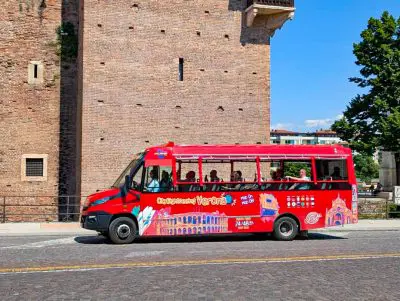 We’re big fans of hop on hop off buses and have used them in many cities all over the world. These kinds of buses are private attractions and as such wouldn’t be classed as public transport. The benefits of a hop on hop off bus is that they offer a sightseeing service on a set route, close to major landmarks in Verona. Passengers can sit on the bus for the entire route and listen to history and interesting facts on an audio guide. Or you can use the bus as a way of getting to the various landmarks, and then once you’ve seen the attraction, jump back on a later bus and head to the next one. Hop on hop off buses in Verona begin at 10am and the last one is at 6pm, with the full loop taking 60 minutes to complete. You can buy a ticket giving you either 24- or 48-hours access to the buses and it will be triggered the moment you board. So, if you board on a Monday and the ticket is 24 hours then it is only valid for the Monday and obviously if its 48 hours then it will end on the Tuesday. Times do not matter, so for example if you trigger the ticket at 3pm on a Monday and it’s a 24-hour pass, then it will still end on the Monday and not 3pm on the Tuesday. This is important to consider if you’re only in Verona for the afternoon, because you will still pay full price, even if you only use it for a couple of hours.
As well as a great option for resting your feet and learning some history on their audio guide. Sitting on the hop on hop off bus will also give you a different perspective of the city. It’s a great option if you’ve already spent the previous day walking around the main attractions and you’re looking for something a little different. But it goes to many of the major locations such as Piazza Bra, Castelvecchio, Castel San Pietro and Giardino Giusti, whilst heading into many of the neighbourhoods in Verona which you may not normally explore by foot.
Taxis and Uber
Taxis are available in Verona and can be found in many of the busy areas such as Piazza Bra. Uber cannot be found within the centre of the city, but it can be used for airport pick ups at Verona Villafranca Airport. There are apps such as WeTaxi, which will book a ride for you using many of the local companies. We don’t really recommend this option of transport, mainly because it costs a lot if you use it regularly. But we understand that it’s not that simple for everyone and many of you aren’t able to drive yourselves when you’re there.
Bicycles
A fun alternative to buses and walking is renting a bike to explore Verona. The city alike many others in Italy is bike friendly and there are bike share and rental services available, with the cost being very reasonable. Shops such as Verona Bike Service offer both pedal bikes and e-bikes, for those looking to use less energy. At a cost of 2 Euros for a 24-hour period, it’s a really cheap and fun idea to add a little excitement to your trip.
E-Scooters
We are seeing more and more e-scooters in cities all around the world, and Verona was one of them. They are permitted in the area where vehicle traffic is restricted, but riding on pedestrian only streets is not allowed.
From Verona Airport to Verona Historic Centre
The journey from the airport to the city centre is only about 15 minutes’ drive, so you can either take a taxi or the Airlink Bus (which takes about 20 minutes). It’s quite cheap to use the Airlink Bus but it only drops you off at the Porta Nuova Station. Luckily the shuttle ticket is valid for 75 minutes and includes public buses, so you can use them to connect to your final destination.
Verona Tourist City Tax – Does It Have One?
Those of us who travel regularly, know that it comes with hidden costs and one of the biggest is tourist city taxes. More and more cities and beach destinations are adding a city tax, to help with the impact of tourists in the area. It’s common place for many European cities to add a few Euros per guest, for each night you stay in a hotel or similar accommodation.
Tourist taxes are commonplace for Italy, and the ‘tassa di soggiorno’ in Verona is similar to those we have seen in other parts of the country. Although not as expensive as other places in Italy such as Rome or Florence, you can still find the costs add up.
Like many other cities in Europe, the Verona tourist tax will vary depending upon the star rating (for hotels or campsites) and type of accommodation you are staying in. The amount is charged per person for each night you are staying in that accommodation. It can be added to the overall cost, so you’re not even aware that you are paying this extra charge. Or you may be asked for it when you check in or leave your hotel or apartment. The current rates from the 01st July 2024 are.
- 1 star hotel or campsite – €1.50 per person, per night,
- 2 star hotel or campsite – €2.00 per person, per night,
- 3 star hotel or campsite – €3.50 per person, per night,
- 4 star hotel – €4.00 per person, per night,
- 5 star hotel – €5.00 per person, per night,
- B&Bs and Holiday Homes – Rates range from €2 to €5,
- Tourist Rentals (apartments such as Airbnb) – €3.50 per person, per night.
The tax will only apply to a maximum of 4 consecutive nights per month, which is great if you are considering staying in Verona for a longer period. As you can imagine, the majority of tourists will only stay in the area for one or two nights. There are some exemptions to paying the tax and they include children under the age of 14 and people with disabilities and their accompanying persons.
As you can see, the rate per person, per night increases as the hotels star rating increases. This may impact where you stay, because although you may find a 5-star hotel at a decent price. Once you add in the tourist tax, it may be outside of your budget. It’s always worth predetermining what the tax will be before you book and establishing whether you are ok with the amount.
Related Guide – Rome Travel Tips and Things to do in Florence, Italy from a Cruise Ship
Verona Card – Attraction Pass
Having used attraction passes on multiple occasions in major cities such as Barcelona and Boston. We will admit that we are big fans for a number of reasons. Firstly, you have a list of attractions at your fingertips, which makes it easier to plan your trip. But it’s also a great way of reducing your overall attraction costs (if used wisely) and you end up seeing more things than you would have, if you had paid for each activity individually.
During our visit to Verona we didn’t use an attraction pass, to be honest we didn’t really think about it. It seems silly now because we would have gained access to more attractions such as Juliets house. If we head back to Verona then we would consider it next time, because we know how valuable they have been in the past.
Within Verona you have the Verona Card, which gives you free entry into the main attractions and museums in the area. You can choose a pass for 24 or 48 hours and it includes the free use of public city buses during that period. The card starts at around 30 Euros, but the price will vary depending on the time of year and day of the week, so our advice is to check online first.
To buy the attraction pass simply head to Verona City Card.com and order online, remembering to choose either the 24- or 48-hour option. If you decide to buy last minute, then you can purchase the pass locally at the tourist information office, museums, churches and participating hotels.
Once you order online you will receive a digital receipt, which needs to be exchanged for a physical card at the Verona Tourist Office. This isn’t unusual, we’ve had to do it in the past in cities such as Paris. The office is near the Arena di Verona, so you don’t have far to walk. The address is IAT tourist information office in Via Leoncino 61, Piazza Bra, and it is open from 9am to 5pm on weekdays and shorter on Sundays. They recommend that you prebook the Casa di Giulietta and we would agree, because queues can be long. There are links on the site to help you book, so we gave them a try, and they were much easier to navigate than the site that we found before our trip.
Activating your card is incredibly easy, you simply head to the first attraction or hop on the first bus and use it. From that point on you will either have 24 or 48 hours, depending on what you have bought. We feel it’s important to clarify the whole 24 and 48 hour, because many people get caught out. Say you activate your attraction pass on Monday at 2pm, then you can only use it on the Monday and not until 2pm on the Tuesday. Same for the 48-hour pass, you can only use it for the Monday and Tuesday. Our advice is if you arrive later in the day to Verona, then wait until the next morning to activate your card to get the most out of it.
As part of the pass you can access more than 15 attractions, which includes fast pass to the Arena di Verona, Casa di Giulietta (Juliets House), Museo di Castelvecchio, Torre dei Lamberti, Basilica of San Zeno Maggiore and Verona Cathedral. Aswell as these top attractions, you’ll also have free admission to many other museums, churches and historical sites. In addition, there are various discounts on city tours and Giardino Giusti which is a sixteenth century palace and Italian garden. Each attraction can only be visited on one occasion, so make sure you have enough time to enjoy them.
During the validity period of the Verona Card, you can also use the ATV-Verona city buses for free. Sadly, it cannot be used for the airport shuttle known as Aerobus or intercity connections. But if you want to take public transport, then simply hold up the card to the reader when you board the bus. We’re not sure why you’d need to use the bus, but it’s there if you need it.
Whether you purchase the Verona Card attraction pass, will depend on how long you are in the city and if you are planning to do a lot when you’re there. For those of you who like to get as much done as possible, then we would highly recommend it. Especially because you can prebook Juliets House and gain faster access to the Verona Arena. The price is pretty decent too, when you consider how much you’ll get to see when you are there. We are kicking ourselves that we didn’t buy the pass, but there’s always next time.
Related Guide – Barcelona Travel Tips and Guide to Visiting Boston
Our List of Attractions and Things to do in Verona Italy
For most of you looking at guides on Verona, this is probably the main thing you’re looking for. Verona doesn’t fail when it comes to attractions, in fact the likelihood is that you won’t get to see everything you want on your first trip. So, the key is to prioritise your list to make sure the essential activities are done.
Hopefully our list is extensive enough to give you all the information you need to plan your city break. Although we didn’t manage everything on our list or chose not to head to certain museums. We have still added the main ones to this guide, so you can choose what you do or don’t want to see.
We’ll begin by bringing you the favourites from our trip and then the popular options. Many of these are simply sights that you will witness as you wander around this great city. Remember that Verona is over 2,000 years old and as such has witnessed a wealth of history in its time.
Juliets House – Casa di Giulietta
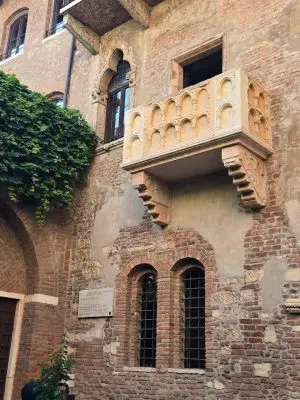
“Two households, both alike in dignity, in fair Verona, where we lay our scene, from ancient grudge break to new mutiny, where civil blood makes civil hands unclean.” You may recognise this quote from the renowned tragic love story Romeo and Juliet by William Shakespeare. Even though it’s a fictional tale and it is said that Shakespeare never left England, the house on via Cappello 23 has become synonymous with the tale. More specifically as the home of the love-struck heroine Juliet Capulet.
We will prewarn you that Casa di Giulietta is the most popular attraction in Verona and can get insanely busy. During our preparation, we struggled to work out booking tickets for the house. If you’re eager to visit, then maybe pre-book a tour via a site such as Viator.
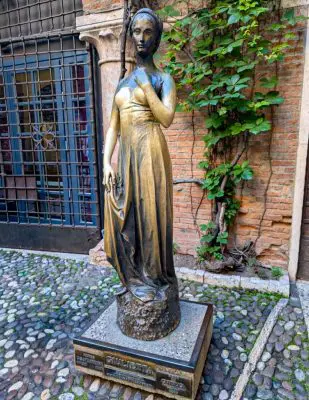
There are two parts to the attraction, with one being free and the other needing a ticket. As you head towards the entrance to the courtyard of Juliets house, you will generally see a large queue and staff directing people in. Our first bit of advice is to get there when it opens or book the earliest ticket and tour. If you purely want to visit the courtyard then you can enter for free, just ask a member of staff if you can go in immediately and skip the queue. This is the option we chose, and it was enjoyable, but also incredibly crowded. There were people clamouring to take a picture with the statue of Juliet and rub her breast, which is supposed to bring luck in love, but we found it tacky. To the right of Juliet is the entrance to the house and of course above it is the famed balcony where Juliet calls out for her beloved Romeo. The visit to the courtyard alone will last around ten minutes but take a moment and head over to Juliet’s red mailbox and leave a letter for her.
If you choose to pay, then you can head inside the medieval tower house, which is said to have been built in 1351. Originally an inn, this building was believed to be the home of the Capulets in the 18th century, hence the connection to Shakespeare’s novel. The building was then acquired in 1905 by the Municipality of Verona and restored, with the beautiful balcony and statue being added.
Once you enter the house, you will see a museum based around the story of Romeo and Juliet. With paintings, sculptures, displays and furniture to suit the era. Even props from movies, such as the bed used in Franco Zeffirelli’s 1968 film. Again, it’s worth remembering that the house and balcony have zero connection to Shakespeare or the tale, mainly because it’s a story. But for many it’s the opportunity to pose as the romantic lovers, on Juliets balcony in the famed city of Verona. We honestly get it; we’ve bought into many tourist traps around the world. If we could have gotten a ticket, we’d probably have done the house and balcony also.
If the balcony photo is really important to you, then our top tip is to leave someone in the courtyard to take the picture and ring to prewarn them when it’s your turn. Otherwise, you’ll end up with a picture of a door frame and the internal part of the balcony.
If you want to visit Casa di Giulietta then it is open from Tuesday to Sunday, between 9 am and 7pm, with last entrance to the house being 6.30pm. The whole visit should take less than an hour, depending on the queues to enter. We have read many reviews and other visitors have stated not to bother and it’s a scam. But if you’re fully aware that it has no connection to the story and is fake, then why not simply enjoy feeling like a romantic heroine for a small amount of time.
Although we had planned on visiting Juliets House, we’re glad we didn’t bother and moved onto seeing other incredible sights in Verona. But that wouldn’t stop us from mentioning it to others visiting the area.
Arena di Verona
The hub of the historic centre in Verona is Piazza Bra, which is the largest main public square in the city. As well as a beautiful park, historic buildings and rafts of cafes or restaurants, there is one stand out structure. The Arena di Verona or Verona Arena is a well-preserved Roman amphitheatre located in the heart of the city. Because of its importance culturally and historically, it has become an iconic symbol of this incredible city.
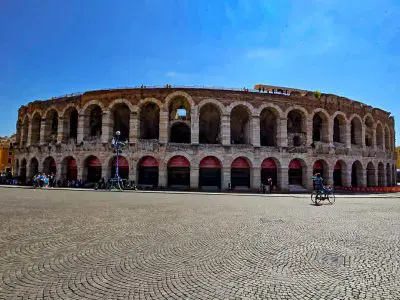
What’s impressive about the Arena is the fact it was built around 30 AD, during the reigns of Emperor Augustus and Claudius. It predates the Colosseum in Rome and is a bigger arena, where public contests with gladiators and other spectacles would be held for up to 30,000 people. An earthquake in 1117 destroyed much of the outer ring leaving only ‘the wing’.
Since the 16th century, the city has made a lot of effort to restore and preserve the structure. Although the Arena has been transformed from the original version of 30 AD, you can still imagine how it would have looked in the by gone era. Imagining how important it would have been to locals as a way of socialising and being entertained.
When you look at the outside ring of the Arena, there is only a short section which is original and made from Valpolicella limestone. The Ala stands out because there are three-order arches which loom over the inner ring.
Sadly, during the reign of Theodoric (493-526 AD), much of the outer façade of the Arena was used as a stone quarry to construct Verona’s second wall. Within the Arena you will see the centre where performances took place and then around the edge was tiered seating for any spectators. It’s crazy to imagine people watching gladiators fighting and cheering, many centuries ago.
If you wish to visit the Arena di Verona then there is a charge, or you can purchase the Verona City Card which has a ‘skip the line’ option available. The Arena is open between Tuesday and Sunday from 9am to 7pm (last admission 6.30pm) but check online because of operatic performances and public holidays.
When you visit Arena di Verona, you can either pay for a tour, or use their audio guide to gain an understanding about the history and architecture of the beautiful structure.
If you’re heading to Verona in the summer, then why not treat yourself and book a ticket to an opera. Every summer since 1913 Verona opera season is held in the arena, with the first performance being Aida by Giuseppe Verdi. Attending an opera here is certainly on our bucket list, because it is one of the most famous opera festivals in the world. When we visited in May 2025, we could see they were in preparation for the opera season, with equipment being taken into the arena.
One of the many reasons we visit these beautiful cities in Italy is to gain an understanding of its sheer breadth of history. The Arena is the perfect way of experiencing life as a Roman, and it’s a beautiful backdrop to the already magnificent Piazza Bra
Piazza Bra
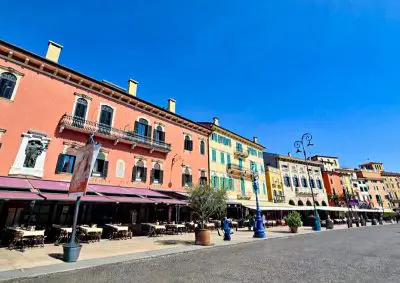
We’ve mentioned it above, so it makes sense for the next thing to see in Verona being the Piazza Bra. This was our first sight of Verona, and for many it’s an iconic emblem of the city. You have probably guessed from the name Piazza Bra, that it is a public square, but this is actually the largest in Verona. It tends to be the hub of the city where people meet and we found that as we walked around, there were lots of school groups sat around the square and in the park.
The beginning of Piazza Bra began in the early 16th century and became a gathering place for Verona’s growing middle class and over the centuries many changes have been made.
What we loved about Piazza Bra is that you can see everything that epitomises Verona in one area. It gives you a window into the history of the city and is where the Veronese have strolled for centuries. Here you will see the ancient Arena di Verona, Palazzo Barbieri (Verona’s Town Hall), and lots of cafes and restaurants along the promenade known as the Liston. Then there is the park which has the beautiful Fontana della Alpi (Fountain of the Alps) and the statue of Vittorio Emanuele II on horseback. It’s an idyllic place to rest those weary feet in the shade with a gelato, as you watch the hustle and bustle around the piazza.
Most of Piazza Bra is vehicle free, but close to one of the main roads you will spot two arches and a beautiful old clock. The Portoni della Bra is from the 14th century and was created to give the time to anyone strolling within the piazza.
If you have the time, then why not take a tour around Piazza Bra or stop in one of the restaurants and enjoy an espresso. This area is particularly busy during opera season, and if you didn’t buy a ticket then you may be able to hear it from the many food spots along the Liston.
Funicolare di Castel San Pietro
We love a good funicular or cable car; it’s the perfect way to see the place you’re visiting from another perspective. So, when we saw that Verona had the Castel San Pietro Funicular, we knew it was a must on our list. The base of the funicular is a 2-minute walk from Ponte Pietra, so it’s incredibly easy to get to. Even better than that is the cost, because a round trip is currently a mere 3 Euros (May 2025), or 2 Euros for one way. You can walk up or down without using the funicular, but there’s something magical about this option, where you can stop for a moment and simply take in those views. The Funicolare di Castel San Pietro is open from 10am to 9pm in the summer and 10am to 5pm in the winter.
The funicular originally opened in 1941 as a way to access San Pietro Castle but ended up closing during World War II. In the 2000’s it was redesigned as an incline lift but has kept the name funicular as a way to remember the original lift.
Once we bought our ticket, we joined the queue and waited for the funicular to arrive. We entered and it was a relatively short journey up in the glass incline lift, so that you can see the emerging views as it glides up. At the top there is a small café and free toilets, which are always a blessing and rare in Italy.
It is here that you will see a terrace with views over Verona, including the Adige River and Ponte Pietra. We have done many funiculars, cable cars and towers, enjoying views over lots of cities and tourist destinations. But we can honestly say that Verona is one of the most memorable views we have ever seen. The curving of the river through the city, the endless red rooves that are seen throughout Verona and the tall Tuscan trees, create a picturesque scene of perfection. Remember to look behind at Borgo Trento and Valdonega, for the many vineyards and green rolling mountains.
You may be wondering why it’s called the Funicolare di Castel San Pietro. That’s because as well as beautiful views, you will also see the Castel San Pietro. Sadly, this isn’t open to the public, but the terraces which surround it give us the opportunity to enjoy some of the best vistas of Verona.
Was Funicolare di Castel San Pietro worth it? In our opinion absolutely, the fact it’s such a short walk from the centre and only 3 Euros. It’s hard to describe the views and sometimes pictures don’t do it justice, so you’ll have to take our word for it and head up there; we are sure you won’t regret it.
Ponte Pietra
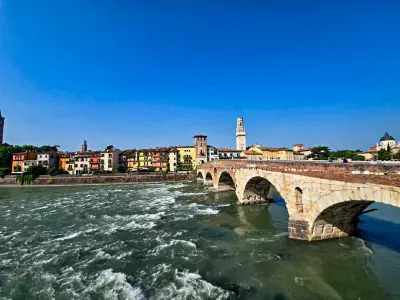
Another iconic image of Verona and for very good reason, is the beautiful stone bridge called the Ponte Pietra. It is the oldest bridge in Verona having been completed in 100 BC and connects the historic centre to Veronetta. As you can imagine the bridge has changed over the centuries, especially after World War II when four of the arches were blown up by retreating German troops. Original bricks and stones were recovered from the Adige River to help reconstruct the bridge.
Even though the arches are from differing historical periods, you can still see two of the original Roman arches on the left bank of the Adige River. Then as you walk over the bridge, there is an ancient Roman ‘stele’ which stands out in one of the arches. This is an upright stone monument and would have been used as a tombstone during the Roman era.
There is more to the Ponte Pietra than age, because this bridge is beautiful and stretches over an ancient ford in the river. This means you’ll hear water rushing beneath you, as you walk along the cobbled path. What really made the Ponte Pietra stand out, is the fact it leads up to a large archway and a long stretch of beautiful buildings which edge the river. This imagery is even more impressive from the Castel San Pietro viewing platform, because it feels like the bridge is welcoming you into the impressive city.
Obviously, you will take plenty of pictures on this architecturally beautiful bridge, but also from the Castel San Pietro. This will give you very differing views, but could we also suggest that as you head under the arch leading into the historic centre, turn left and wander along the path by the rivers edge. Along here you will see the Ponte Pietra in all it’s glory, with the rushing water below.
Ponte Pietra is one of our favourite memories during our time in Verona. Whether it was strolling along the riverbank with a gelato, walking onto the famous bridge itself, or the breathtaking views from the Castel San Pietro.
Piazza della Erbe
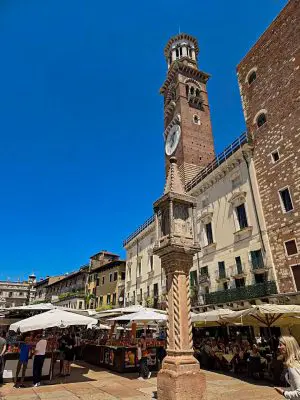
We must admit that having been to Piazza Bra, we much preferred Piazza della Erbe. Nothing against Piazza Bra, but we found Piazza della Erbe or Herbs Square, to be absolutely beautiful. It is the oldest square, having been built on an ancient Roman Forum, and is located more centrally in the historic centre, with Juliets house being extremely close by. The forum was an important spot for Roman social and economic life, in fact the name Erbe relates to its historic herb and spice market. Interestingly even today you will find daily market stalls selling food items, clothes and souvenirs. This means that it can get busy in that area and there’s a greater chance of pick pockets, so be careful.
What really made Piazza della Erbe stand out wasn’t the market, it was the beautiful surrounding buildings, fountains and statues which are dotted around the square. If you like to do a little shopping as you travel, then definitely take a moment to look around the market and see what they have. But also head back later in the day (after 6pm) when the market has gone, so that you can take a proper look at the piazza.
Around the central square of the piazza, you will see the usual shops, cafes and restaurants which are ideal for people watching. Other buildings to the North include the Palazzo della Ragione (Palace of Reason) which was the original town hall. Then you have the Torre dei Lamberti which is a clock tower, the Casa dei Giudici (House of Judges) and the beautiful, 14th century frescoed buildings called the houses of Mazzanti. These Renaissance wall paintings display Verona’s rich history and they are absolutely stunning, in fact they are probably the first things you will see as you walk into the square, they are so eye catching.
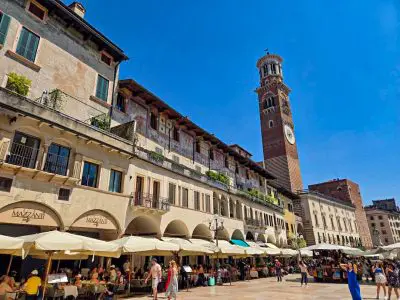
Then to the west you have the Palazzo Maffei, which was originally a 17th century Baroque palace but is now an art museum called Casa Museo. The building is adorned with several Greek gods such as Jupiter, Hercules, Venus, Mercury and Apollo. To the south is another beautiful building called the Domus Mercatorum which was home to the Casa dei Mercanti, the guild of the city’s merchants.
Aswell as buildings you will also see numerous monuments, including a fountain called Madonna Verona which is from the Roman era 380 AD. Another historic monument is the capital called Tribuna or Sedan which looks like a podium. This is from the 13th century and was used for public occasions.
At the centre of Piazza Erbe is a bronze statue of a woman holding a sword with her arm stretched towards the sky. This is a monument commemorating one of the first civilian bombings in history, more specifically during World War I, when Austrian planes bombed Piazza Erbe during market hours.
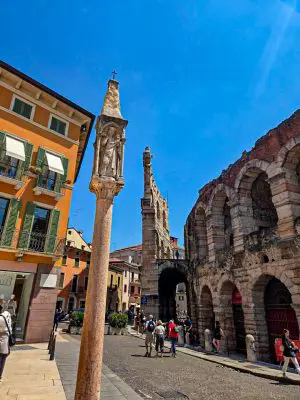
If all of this isn’t enough, you will also see St Mark Lion’s Column. It is made of white marble and has the Lion of San Marco, which is the symbol for the Republic of Venice on top. The second is a 14th century column topped with a newsstand, which has carved figures of the Virgin and Saints Zeno, Pietro Martyr and Christopher.
If all of this isn’t enough for one spectacular public square, then you have the famous Rib Arch. Hanging from an arch connecting the Palazzo della Ragione to the Domus Nova, is a gigantic rib which is rumoured to be a whale bone (although some believe it to be an ichthyosaur fossil). In reality it was probably an unusual object placed there by the apothecary who had his store nearby, as a way to attract curious customers.
As you can see, there is plenty to experience in this small area, so make sure you give it a little time before heading to your next activity. The piazza is very different during market hours, so maybe try and head there through the day and later. The many sights, monuments and buildings, makes Piazza Erbe a special place and we’re sure you’ll love it.
Porta Borsari
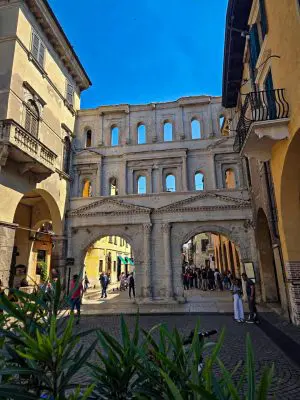
For those of you who love free things to do, then this is one of those items for your list. Just because it’s free doesn’t mean it’s not exciting, because the Porta Borsari is only a 5-minute walk from Piazza Erbe. It’s an ancient Roman gate dating from the 1st century AD. This huge, impressive gate was actually the main entrance to the city, which is why it is beautifully decorated on the outside. The white limestone façade has two large arches, with multiple small window arches above.
It may only take a couple of minutes of your day, but it’s worth heading over so you can imagine what this huge gate would have looked like to visitors of the city.
Verona Cathedral
Verona Cathedral is an imposing sight as you walk around it, but even more so if you head up the Castel San Pietro Funicular and view it from the terrace. The entire complex is huge, consisting of the Cathedral dedicated to the Assumption of Mary, the Church of San Giovanni in Fonte, the Church of Sant’Elena and the Cloister of the Canons. If you choose to visit all four churches then you can buy a multi pass ticket, but a single ticket to the main Cathedral is currently 4 Euros (May 2025).
We have to be honest and say that we didn’t go into the Cathedral, just wandered around the outside. So, this review comes from research of others who visited the inside. It was our second week travelling around Italy and we had seen a few churches and Cathedrals at that point, including Milans, Lake Comos and the famous Saint Mark’s Basilica in Venice.
Verona Cathedral is around 20 minutes’ walk from Piazza Bra, being closer to Ponte Pietra which is only a 5-minute walk. Built in the 12th century, the cathedral was dedicated to Saint Maria Assunta. Having been badly damaged by an earthquake in 1117 A.D. it was rebuilt into its current Gothic design and two Romanesque porches.
Sadly, as we’re finding more and more, not only do you have to purchase a ticket for the cathedral, but there’s an extra charge for the audio guide. But sometimes it’s worth it, especially if you enjoy impressive religious architecture and you have the time to stroll. Verona Cathedral is open daily from between 11am to 5pm, although this is different on Saturday and Sunday due to services being held there.
When inside you will see three naves with ribbed vaults and five spans, divided by eight elaborate marble columns. There’s also lots of artwork such as the Assumption of the Virgin by Titan from 1535, an octagonal baptismal font made from a single block of marble, frescoes, red Veronese marbles, altars and three pipe organs.
As we mentioned at the start of this section, we didn’t visit Verona Cathedral purely because we had been into so many. But if you’re only heading to Verona on a city break, then visiting a cathedral is a must.
Arco dei Gavi
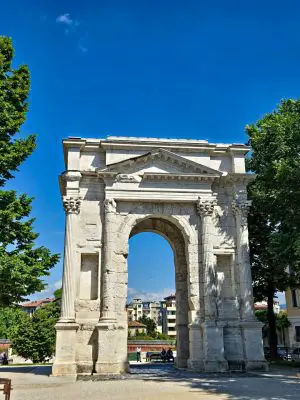
Italy is one of those countries where simply by wandering around, you are witnessing incredible historic sights. The best part is that they are free, but this doesn’t make them any less impressive. Arco dei Gavi is one of these structures.
It can be found to the right-hand side of the Castelvecchio Museum and overlooks the Adige River. Sadly, as with many unprotected structures, there was some vandalism written on the brick work. This is sad when you consider that this is an arch from the first century, by the Roman architect Lucio Vitruvio Cerdone. Arco dei Gavi was originally located somewhere else, to celebrate an important family in Roman Verona called the Gavia Gens. As with many arches from the Middle Ages, it was used as a city gate between the Scaliger walls and the Tower. During Napoleonic occupation it was demolished and transferred to the Arena, but then reassembled in 1932.
The arch itself is made from local white limestone and has four sides, with a single archway framed by Corinthian columns, triangular tympanum and plant bas-reliefs. The internal ceiling has a medusa head and statues representing members of the Gavi family. You will spot on the floor under the arch there are markings, which are areas worn from passing wagons.
We enjoyed looking at the Arco dei Gavi, it was a quick visit, but we liked the architecture and beautiful views over the Adige. It’s in an ideal location between many of the top attractions, especially if you’re planning on visiting Castelvecchio.
Ponte Scaligero
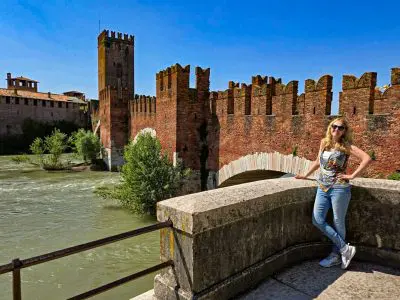
Ponte Scaligero is also known as the Castelvecchio Bridge or Verona’s Scaliger Bridge. This beautiful, red brick fortified bridge is very stately by design and connects Castelvecchio which is a late medieval castle, to the left bank of the Adige. Ponte Scaligero had the worlds largest span at the time of its construction, which was between 1354 and 1356. Most of the bridge has been rebuilt due to the fact it was bombed by fleeing German troops in 1945. It was reconstructed to look the same as the original and using recovered materials, like Ponte Pietra.
We loved how much the bridge reflected the architecture of the castle, with what looked like turrets. Walking over this impressive bridge is a must for your trip to Verona, so you can enjoy the scenery around you including the fast-flowing Adige River.
Piazza dei Signori
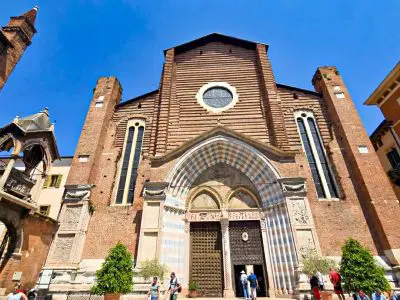
Only a 2-minute walk from Piazza Erbe is Piazza dei Signori, which is a closed in square of significance, both historically and artistically in Verona. After the manic atmosphere in Piazza Erbe, we found the peace and solitude in Piazza dei Signori quite pleasant. Known as the ‘hall of Verona’ there are various architecturally beautiful buildings such as the 12th century city council, which displays a Veronese Romanesque style. Also, the Scala Family Palace which was the home of lords who ruled Verona at the time, Domus Nova which is where judges lived, Loggia del Consiglio a renaissance styled building and Palazzo del Capitano the headquarters of military power in Verona. As you would imagine with a piazza in Italy, there is a statue in the centre, and this one is of Dante the poet who lived in Verona for a period of time.
The name Piazza dei Signori expresses the level of political power in medieval and renaissance Verona. Within this square is where lords lived and worked, but also members of the Scala family.
Teatro Romano
Found on San Pietro Hill is the Teatro Romano or Roman Theatre and for those of you heading up the Castel San Pietro Funicular, you can see it below. The theatre was built in the 1st century BC and is one of the cities oldest buildings. As well as visiting the arena itself, you can also go into the adjacent Archaeological Museum which is home to Roman artifacts, sculptures and mosaics. They were found during excavations of the Castel San Pietro in the 1800s.
Teatro Romano is open every day from 10am to 6pm, except for Monday when it’s closed. When we visited it cost 6 Euros (May 2025), which is a great price for such a historic venue. There is a summer theatre season held there with plays and music events.
During our initial research we got a little confused about whether the Verona Arena and Roman Theatre was the same. Many of the travellers’ guides were confusing, it was only when we arrived in Verona that we worked it out. If you had to choose one then we would opt for Verona Arena, it’s a little more iconic and impressive.
Scaliger Tombs
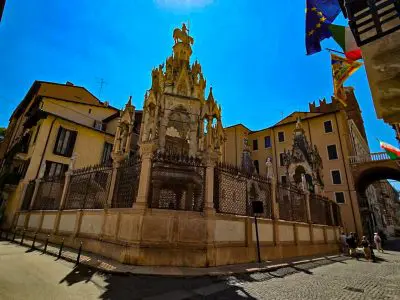
Found next to Piazza dei Signori, are the tombs of one of the most influential families in the history of Verona. This is a great one for your to do list, because it’s close to the main attractions and you can simply stop by and take in its beauty from the street. The tombs are safe guarded by an iron fence, and within the courtyard you will see the families’ sarcophagi which are positioned on the ground or on raised surfaces. The main structure began construction in 1345 and is called the ark of Mastino II, with reliefs depicting sacred scenes and statues of the four virtues. A statue of Mastino II can be seen on the lid, watched over by two angels.
You can visit the courtyard between April and September, for a small fee, but we enjoyed the view from the street. Interestingly this was one of the memorable moments of our trip to Verona. The tombs were impressive to see and reinforced the importance of the Scaliger family to the region.
Giardino Giusti
Giardino Giusti is a 16th century Italian Renaissance garden, which can be found in the Veronetta district of Verona. It is a bit of a walk from the historic centre of the city, but if you are close to the Ponte Pietra, then you can get there in 10 minutes. The ticket price is around 12 to 13 Euros (May 2025) and opening hours vary depending upon the season. But during the summer Giardino Giusti is open between 9am and 8pm.
The garden is a nice size, meaning there’s plenty of space to stroll, but not too big that it takes up the whole day. Entering the gardens is typically Italian, because outside is a small unassuming street and you walk through a door into spectacular views; the contrast is unbelievable. Within the walls of this palace is quintessential Italian garden design. You will see mythological statues, fountains, alleys of long beautiful cypress trees, grottoes and a labyrinth. There are great views from the upper belvedere via a spiral staircase, of the city below. If you love to take part in local myths, then make sure you head to the maze, because legend has it that finding your partner in there guarantees lasting love. The palace and apartment are also open to visitors, so it’s worth popping in and taking a look.
Castelvecchio Museum
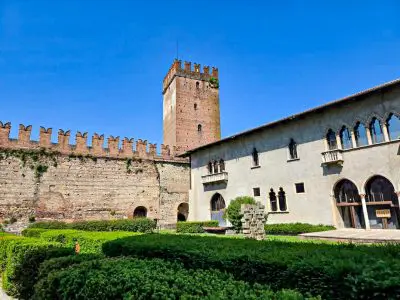
Castelvecchio is one of the top attractions in Verona and although it was impressive, it wasn’t the most memorable part of our trip. The walk from the arena to the castle is around 10 minutes, but it is through beautiful winding streets. Many of the other attractions are on the way, so it’s still worth popping by.
Built in the 13th century Castelvecchio or the Old Castle, was used as a deterrent to Verona’s powerful neighbours. It was constructed by the renowned Scaliger family as a military fortification and an option of escape should they need it, over the connecting bridge.
It’s one of the smaller castles we have seen, but to be fair we are from the United Kingdom where castles are the norm. The red bricks and merlons of both the gothic style castle and bridge are iconic, but they still have an authentic Italian vibe. Castelvecchio has seven towers and four main buildings, with one housing the museum. There is a dried moat around the front of the castle, which originally was filled by water from the Adige River.
The Castelvecchio Museum displays an impressive art collection from the medieval, Renaissance and even modern era. The 29 exhibition halls hold a collection which includes Italian and foreign paintings, sculptures and archaeological finds such as ancient weapons, miniatures and ceramics.
Admission to the museum and castle is 9 Euros (May 2025), but you can walk around the outside walls and inside the courtyard for free. The museum is closed on Monday, and open between 10am and 6pm on the other days. We personally didn’t go into the museum, but we walked around the courtyard and outer walls. If you enjoy art and history then this is the ideal addition to your trip, especially because the price is quite reasonable.
Additional Attractions in Verona
Above is the list of the main attractions in Verona, many of which we visited, but there are still others we didn’t make it to. To give you a comprehensive guide, here are the additional attractions that you may wish to visit. During our time we sadly didn’t have the opportunity, but hopefully we will in the future.
- Basilica di san Zeno Maggorie – This minor basilica in Verona was built between 967 and 1398 AD, with Romanesque architecture. Interestingly this basilica has become popular, because it is said to be the crypt where the marriage of Shakespeare’s tragic lovers Romeo and Juliet was held. We have read that entry to Basilica di san Zeno Maggorie is 7 Euros, and it is open daily (except Sunday), with hours varying depending on the season.
- Basilica di Sant’ Anastasia – This basilica is one of the largest of the 40 churches in Verona and can be found in the centre of the historic district. Construction began in 1260 and finished 1440, with its design being a masterclass in Italian Gothic style. It kept its name from the pre-existing church from the Lombard period, which was dedicated to the 4th century martyr Anastasia. The basilica covers three large aisles which are supported with red Veronese marble. Basilica di Sant’ Anastasia is open daily, but the hours depend on the day of the week and season, so our advice is to check online. There is an entrance cost which is currently 4 Euros (May 2025), but if you’re planning on visiting the main basilicas in Verona then look at buying the cumulative ticket for several churches.
- Chiesa di san Fermo Maggiore – Dedicated to the local martyrs Saint Firmus and Rusticus, this church interestingly is famous for having two parts. The lower church is from the 11th-12th century and is Romanesque in style, but the upper larger church is from the 14th century and is Gothic. Opening hours vary, similar to the other churches and basilicas, depending on the day of the week and season. It’s also 4 Euros to enter the church, but inside you will see beautiful frescoes, bronze portals and it once held the tomb of a Scaliger family member. The Church of St Fermo Maggiore can be found next to the banks of the Adige River.
- Santuario della Madonna di Lourdes – Found on the hill of San Leonardo is the Sanctuary of Our Lady of Lourdes, which was an ancient monastery and church from the 12th century dedicated to the protector of prisoners. Over the years it has been used in various ways, including a political prison by Nazi-Fascists. Visiting the sanctuary is free and it’s open all year round, but you can pay for a specialised tour.
- Galleria d’Arte Moderna Achille Forti – The modern art gallery is found within the historic Palazzo della Ragione, next to the Piazza dei Signori. Inside the gallery is works of art from the 19th century to the present day, with many artists hailing from the Veneto region. Aside from being closed on Mondays, the Achille Forti Modern Art Gallery is open from 10am to 6pm and costs 6 Euros to enter.
- Palazzo Maffei Casa Museo – This art museum offers over 700 pieces including paintings, sculptures, applied arts and architecture. It offers a focus on Veronese artists including Italian Futurism, plus modern and contemporary art. The cost to enter is currently 15 Euros (May 2025) and you can visit every day (except Tuesday) between 10am and 6pm.
- Museo di Storia Naturale – The Natural History Museum of Verona is a great option if you’re travelling with kids, or you want a break from the Italian heat. As you would imagine there are exhibits on local natural heritage, palaeontology, geology and zoology. General admission is 9 Euros and aside from being closed on Mondays, the museum is open daily from 10am to 6pm.
- Museo Archeologico Nazionale di Verona – The National Archaeological Museum of Verona, is home to artifacts from the most significant excavations in the Verona area. There is a section dedicated to prehistoric and protohistoric sites, and to the Roman era. Open Monday to Friday from 10am to 6pm, the tickets cost 5 Euros.
- Museo degli Affreschi – Also known as G.B. Cavalcaselle museum, this is a modern art history museum known for its collections in Italian and Flemish painting. The collection includes many frescoes from between the 19th and 20th century, giving a view into medieval and Renaissance art. Within a small bunker of the museum is a red marble sarcophagus which is said to be Juliets tomb (from Romeo and Juliet). Entrance to the museum is 6 Euros and it is open every day except Monday from 10am to 6pm.
- Foundation Museum Miniscalchi Erizzo – This museum displays a collection of art, antiquities, Renaissance bronzes, ceramics, weapons and Russian icons. The ticket price is 8 Euros and is open every day except Tuesday and Thursday.
 Our Verona Top Tips
- Wearing comfortable shoes is a must – Verona is a very walkable city; in fact, it was the only way we got around the different suburbs. Although you could take public transport, we would always recommend enjoying those cobbled Italian streets. If you’re a city break traveller, then you will know how easy it is for those steps to add up. You will find that you can spend hours either walking or queuing for an attraction, so comfortable shoes are essential to make it easier. If you have a trusty pair of trainers then they are perfect, because there’s always a chance they’ll get dirty as you wander around. Travel is hard enough without your feet burning because you picked the wrong shoes.
- Think about the weather – We’ve mentioned this already, but preparing for weather in the place you’re visiting is essential to make it comfortable and enjoyable. Europe can be incredibly hot in the summer, but also have heavy rainfalls thrown in. This is why you should prepare for anything, and by that we mean wet proof gear, umbrella, sun hat and sunglasses. Once you’ve checked the weather apps, you’ll have a better idea of what to take with you. Just an extra tip from us, make sure you look at the temperature as well as the type of weather. During our 3 weeks in Italy, we had a mixture of weather, from full on down pours to glorious sunshine. We have been to Italy in Spring and Autumn months, where we have needed coats because it’s been cold.
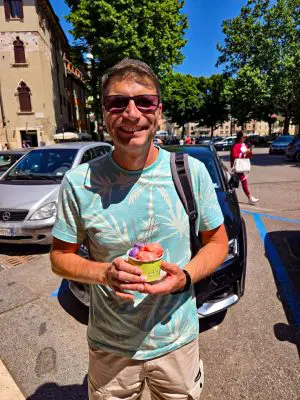
- Give yourself time to relax – You’re in this fabulous city which means one thing, lots of walking. The best thing about Verona is that there isn’t lots and lots of things to do. Don’t get us wrong, you’ll see plenty when you are there, but the city is so beautiful it would be a shame to not take a moment and relax. Italy has so much architectural beauty, it feels like you’re walking through history. So, take a moment and visit a restaurant in one of the many Piazzas, stroll through the historic centre or grab a gelato and sit on a bench near the Adige River (yes, we did this and highly recommend it). We promise you that taking a moment to rest won’t feel like wasted time, in fact it’s one of the lovely memories we have from our trip.
- Prebook Juliet’s Balcony – The most popular attraction in Verona is Juliet’s Balcony or Casa di Giulietta. We really struggled to work out the official site for the house and balcony, so ended up not visiting. You can walk into the courtyard and see the Juliet statue and her balcony above for free. But if standing on the balcony is on your bucket list, then prebooking is a must. Next time we would get tickets from a company such as Viator, who have fast-tracked options at reasonable prices. Although we understand why Juliet’s Balcony is so iconic, having been a key moment in William Shakespeares ‘Romeo and Juliet’. It’s worth remembering that Juliet was a fictional character and so this is purely just a tourist trap, even if we do love a good touristy spot. The queues for entering the house were crazy on the two occasions we visited the area, but thankfully we could skip the queue because we were just looking at the courtyard. If you’re only there for the day, it’s worth considering if you want to spend a chunk of your time queuing for something with no historical significance.
- Centro Commerciale Adigeo – We know you can shop at home, so why would you want to visit a shopping centre when you’re in Italy. Sometimes a break somewhere air conditioned, may just be what the doctor ordered. We love clothes shopping in other countries, especially trying out new brands. When we wear the clothes in the future, they remind us of the country we bought them from. Centro Commerciale Adigeo is a 10-minute drive from Piazza Bra, so it’s a distance if you don’t have a car. Thankfully we did, so spent a couple of hours there looking at the clothing shops, grabbing a coffee and picking up some groceries from the supermarket. There is public transport available which will take you about 25 to 30 minutes by bus.
- Think about Mondays – As with most cities in Italy, many museums are closed on Mondays, which can be a big problem if that’s the only day you are visiting Verona. If you can, our advice would be to visit another day, but if you are in the city for a couple of days then use Monday to see all those activities which do not require entry, such as the bridges and piazzas.
Should I Visit Verona?
 As we planned our three-week Italian road trip, we tried to work out the perfect route around the north of the country. We had found amazing flights to Milan and knew that Venice and Modena had made our list. Having heard many friends mention Verona we decided to add it to the itinerary, not knowing much about the city apart from it being the home to the passionate and tragic characters of Romeo and Juliet.
Verona quickly became one of our favourite cities during the trip, because it offered a mixture of beautiful architecture with a wealth of history. The best part of Verona is that even if you only have a day to spare during your trip, then you can pretty much get most of our list of attractions completed; depending on what you want to do. Plus, there is a nice mixture of things to see and do, because sometimes when you’re visiting Italy it can feel like you spend all day seeing churches or duomos.
Because we stayed a little longer than we probably needed to in Verona, it gave us the chance to take it a little slower and wander around areas which aren’t heavy with tourists. In comparison to Milan and Venice, Verona is much quieter in general, although there were lots of school trips which could be little annoying.
As we have mentioned throughout this guide, the architecture in Verona is breathtaking. We especially loved taking the Castel San Pietro Funicular to the top of Castel San Pietro. It offers that panoramic view of the city which will cause your heart to beat a little faster.
For many, the reason for their visit to Verona is to trace the footsteps of the heroine Juliet. Getting into her house and standing on the famous balcony is difficult due to its popularity, so make sure you prebook as soon as you can.
Would we recommend Verona, that’s an emphatic yes, it feels authentically Italian alike Modena, but with some of the touristy bits that we love. The only thing we would have changed when we visited is the length of time we stayed there. It was a little longer than we needed and we could have used the extra day in Lake Garda or Lake Como. But it gave us the opportunity to truly dive into this amazing city and enjoy the picturesque squares, cobblestone streets and enchanting views along the Adige River.
Related Guide – Guide to Visiting Modena
If you do end up visiting Verona, then make sure you tag us on Instagram, because we love to see what you’re up to as you tick off your bucket lists.